
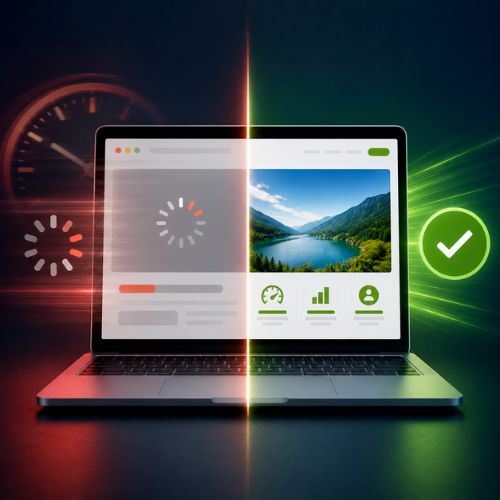
Slow Websites Cost You Traffic & Customers
For years, business owners were told that SEO was mostly about keywords, backlinks, and publishing content regularly. While those things still matter, Google’s priorities have shifted in a big way.
In 2026, website speed and overall user experience (UX) are becoming some of the biggest ranking factors affecting both search visibility and conversions.
The reason is simple: Google wants to recommend websites people actually enjoy using. If your website loads slowly, feels outdated on mobile devices, or frustrates visitors, users leave quickly. Google notices that behavior.
And now, with AI-powered search results becoming more common, UX matters more than ever. Search engines are increasingly prioritizing websites that genuinely help users instead of simply matching keywords.
For business owners, this means your website is no longer just an online brochure. It directly impacts your SEO, your lead generation, and your sales.
Why Google Cares About Website Speed
Think about your own browsing habits for a second. If a website takes more than a few seconds to load, what do you usually do?
Most people leave.
Google has years of data showing that users prefer fast, smooth websites. Slow loading pages create frustration, especially on mobile devices where people expect instant access to information.
That’s why Google introduced Core Web Vitals, a set of performance metrics designed to measure how fast and user-friendly a website feels. These metrics look at things like:
- How quickly the page loads
- How fast users can interact with it
- Whether the layout shifts around while loading
- Mobile responsiveness
- Overall visual stability
In other words, Google is evaluating how your website feels to real people, not just search engines.
A website that loads in two seconds will almost always outperform a website that takes eight seconds, even if both businesses offer similar services.
Slow Websites Hurt More Than Rankings
The impact goes beyond SEO.
A slow or outdated website can quietly hurt conversions without business owners even realizing it. Visitors may still find your business online, but if the experience feels frustrating or untrustworthy, they leave before contacting you.
This is where bounce rates become important.
A bounce happens when someone lands on your website and leaves without interacting further. High bounce rates often signal that users are not finding what they need quickly enough or that the site experience feels poor.
Common reasons people leave websites include:
- Pages loading too slowly
- Confusing navigation
- Tiny mobile text
- Pop ups blocking content
- Outdated design
- Broken buttons or forms
- Poor mobile formatting
Even if your SEO strategy is strong, these issues can stop visitors from turning into actual customers. Businesses are finally starting to realize that SEO and web design are no longer separate conversations. They work together.
Mobile Experience Is No Longer Optional
More than half of all website traffic now comes from mobile devices, and for many industries, that number is much higher. Google also uses mobile first indexing, meaning it primarily evaluates the mobile version of your website when determining rankings.
If your site looks great on desktop but feels clunky on a phone, you could already be losing visibility in search results.
A mobile friendly website should:
- Load quickly on cellular networks
- Have easy to tap buttons
- Display readable text without zooming
- Fit properly on smaller screens
- Make forms simple to complete
- Keep navigation clean and intuitive
This matters because user behavior has changed dramatically over the last few years. People search while multitasking, driving, shopping, or comparing businesses on the go. They expect websites to work instantly.
If your competitors provide a smoother experience, users will choose them instead.AI Search Is Raising the Standard
AI-powered search results are changing how people interact with Google.
Instead of just displaying a list of websites, search engines are increasingly trying to surface the most helpful, trustworthy, and user-friendly answers immediately. That means Google is paying even closer attention to engagement signals and overall website quality.
If users quickly leave your site after clicking, that sends negative signals about the experience. If visitors stay longer, explore multiple pages, and engage with your content, Google sees that as a positive sign.
This is one reason why modern SEO is becoming more focused on the full customer experience rather than just rankings alone. Fast websites tend to keep users engaged longer. Clean layouts help visitors find answers faster. Better experiences create more trust.
Everything is connected now.
What Business Owners Should Focus On
The good news is that improving website speed and user experience does not always require a complete redesign.
Small improvements can make a major difference, including:
- Compressing oversized images
- Removing outdated plugins
- Improving hosting quality
- Simplifying page layouts
- Optimizing for mobile devices
- Fixing broken links or forms
- Reducing unnecessary animations
- Improving page navigation
Even updating an older website with modern performance improvements can dramatically improve both rankings and conversions.
The key is understanding that your website should work for users first.
Google’s algorithm is increasingly rewarding businesses that provide fast, helpful, frustration free experiences. And honestly, that is good for everyone. Better websites create happier visitors, stronger engagement, and more leads.
Final Thoughts
Website speed and user experience are no longer “nice to have” features. They are becoming core ranking factors that directly affect visibility, traffic, and conversions. Businesses that ignore these issues risk losing both rankings and customers to competitors with faster, more user friendly websites.
The good news is that most improvements are practical and achievable. Even modest updates can improve performance, reduce bounce rates, and help turn more website visitors into actual customers.
In 2026, SEO is no longer just about getting people to your website. It is about giving them a great experience once they arrive.
If your website feels outdated, loads slowly, or is not converting visitors the way it should, now is the time to address it.
TAG Digital Marketing (TAG), helps businesses create faster, more user friendly websites that support both SEO performance and long term growth. From mobile optimization and Core Web Vitals improvements to modern web design strategies, our team can help turn your website into a stronger marketing tool for your business.
Ready to stop losing traffic and start turning more visitors into customers? Let TAG help you build a website that works harder for your business. Contact us today!